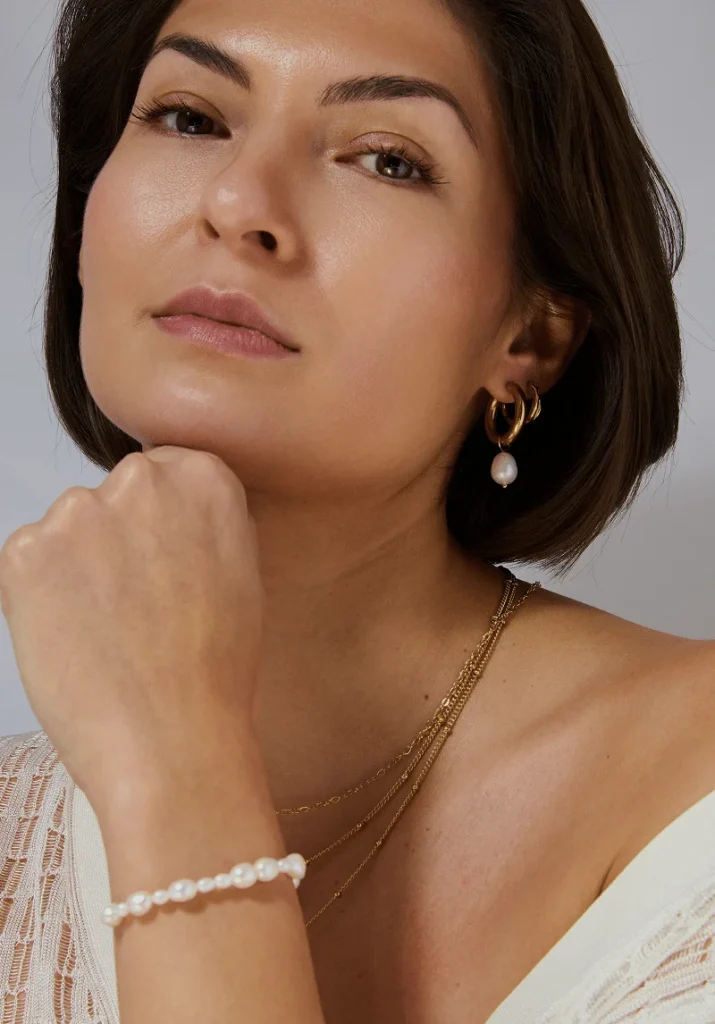


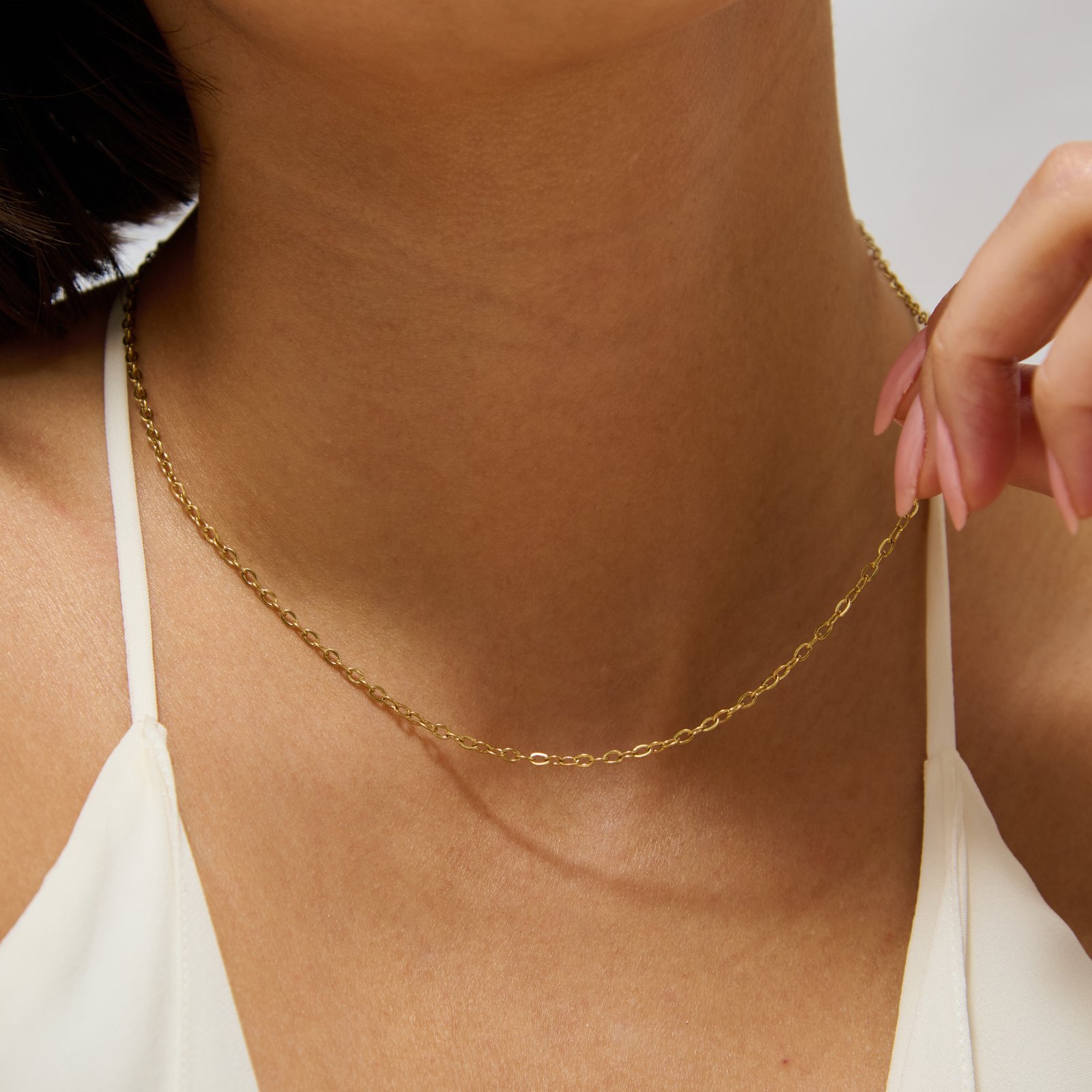
Most of us have ordered a chain online, slipped it on, and felt that small flicker of doubt at the mirror: a touch high, a touch low, not quite where we pictured. A minute with a ruler removes that guesswork. To measure necklace length, lay the piece flat in a straight line and measure from end to end, clasp included, with a ruler or tape measure. That single figure is the length jewellers quote. If you would rather find the size that suits you than measure something you already own, run a soft tape around your neck at the height you want the necklace to sit and read off the number. Both take about a minute and need nothing more than a ruler or a length of string.
How do I measure a necklace I already own?
Undo the clasp and lay the necklace flat on a table in a straight line, with no slack or curl. Place a ruler or tape measure along it and read from one end to the other, including the clasp and any extender. That number is the full length, which is how necklaces are sized and sold.
If the necklace has a pendant, measure the chain on its own for the standard length, then note how far the pendant hangs below the lowest point of the chain to get the full drop. For a piece you never unclasp, lay it flat as a closed loop, measure across from the top to the bottom, then double that figure for the full length. A piece of string laid along the chain and then held against a ruler works just as well when you have no tape measure to hand.
Keep the chain in a straight line as you measure, with no kinks or bunching, since slack adds length that is not really there. A flexible dressmaker tape sits along the chain more easily than a rigid ruler, though either does the job. If the necklace tapers or carries stations of beads, the full end-to-end figure still applies; the beads make no difference to how the length is quoted.
How do I measure my neck for the right size?
Take a soft tape measure and wrap it around your neck at the height you want the necklace to sit, comfortable and never tight. Read the measurement where the tape meets. That figure is roughly where a choker would close, so for a necklace that hangs loosely instead of gripping, add to it depending on the drop you want.
As a rough guide, add about five centimetres, around two inches, for a necklace that sits just below the throat, and more for a longer drop. With no tape measure to hand, wrap a length of string or ribbon around your neck, mark where it meets, then hold it flat against a ruler. Holding a piece of string at different drops in front of the mirror is the simplest way to see where each length will land before you buy.
A worked example makes this concrete. If the tape reads 33cm around the base of your neck and you want the necklace to sit just below the throat, add about 5cm for a length near 38cm, which is a high choker. For a princess length that rests on the collarbone, aim closer to 42 to 45cm. For a piece that drops to the upper chest, look at 50cm and up. Working from your own neck measurement this way takes the guesswork out of ordering.
What length is my necklace once I have measured it?
Match your figure to the standard named lengths. About 14 to 16 inches is a choker, sitting high on the neck. About 17 to 19 inches is a princess, the most common length, sitting on or just below the collarbone. About 20 to 24 inches is a matinee, falling to the upper chest. About 28 to 36 inches is an opera, sitting low on the chest or below.
Many UK necklaces are given in centimetres, so it helps to convert. Forty centimetres is about 16 inches, 45cm is about 18 inches, 50cm is about 20 inches, and 60cm is about 24 inches. An 18-inch or 45cm chain is the standard everyday length most brands ship by default, which is why it is the figure to compare yours against first.
If your figure falls between two named lengths, treat the longer one as the better guide, since a chain that sits a touch low still wears well while one that sits high can feel tight. Note any extender too: a chain listed as 45 to 50cm covers the upper princess range, so it can be set short for a higher sit or let out to reach the start of matinee. Recording both the shortest and longest setting tells you the full range a single adjustable necklace gives you.
How accurate does the measurement need to be?
Within about a centimetre is close enough for choosing a necklace. A centimetre or two shifts where a chain sits only slightly, and most of that is absorbed by the way a necklace drapes. Accuracy matters more at the joins between layered chains, since small differences in length are what keep the lines separate and free of tangles.
Measure with the necklace laid flat instead of held up, because a hanging chain stretches under its own weight and reads longer than it is. Keep the tape or ruler straight along the chain with no curve. If a necklace has an adjustable section, measure both the shortest and the longest setting so you know the full range it covers.
It also helps to measure on the same surface each time. A chain measured on a soft cloth can shift and read slightly long, while a flat hard table gives a steadier line. For pendants, measure the chain first, then hold a ruler vertically against the pendant to note its drop, so you can describe both the chain length and the total fall when you need to.
How do I use my measurement when layering?
Once you have the length of each chain, plan the gaps between them. Leaving roughly two to five centimetres, about one to two inches, between each layer keeps them sitting as separate lines. So a 16-inch chain, an 18-inch chain and a 20-inch chain step neatly down the chest with even spacing.
If two chains you own are close in length, an adjustable extender opens the gap without buying a new piece. Even a 2cm extender is enough to separate two chains that would otherwise sit on top of each other, and a 4 to 5cm difference gives a clearer step that keeps each chain legible as its own line. Measuring first means you can pick the next chain to fill a clear gap instead of guessing, which avoids two lines that overlap and tangle.
FAQ
Do I include the clasp when measuring a necklace?
Yes. Measure the full length end to end including the clasp and any extender, because that is the figure jewellers use to size and sell necklaces.
How do I measure a necklace without a tape measure?
Lay the necklace flat and run a piece of string or ribbon along it, mark where it ends, then measure the string against a ruler. The same trick works for measuring your neck.
How do I measure a necklace I cannot unclasp?
Lay it flat as a closed loop, measure from the top of the loop to the bottom, then double that number to get the full length.
What is the standard necklace length?
Eighteen inches, or 45cm, is the standard everyday length. It is a princess length that sits on or just below the collarbone and suits most necklines.
Related pieces
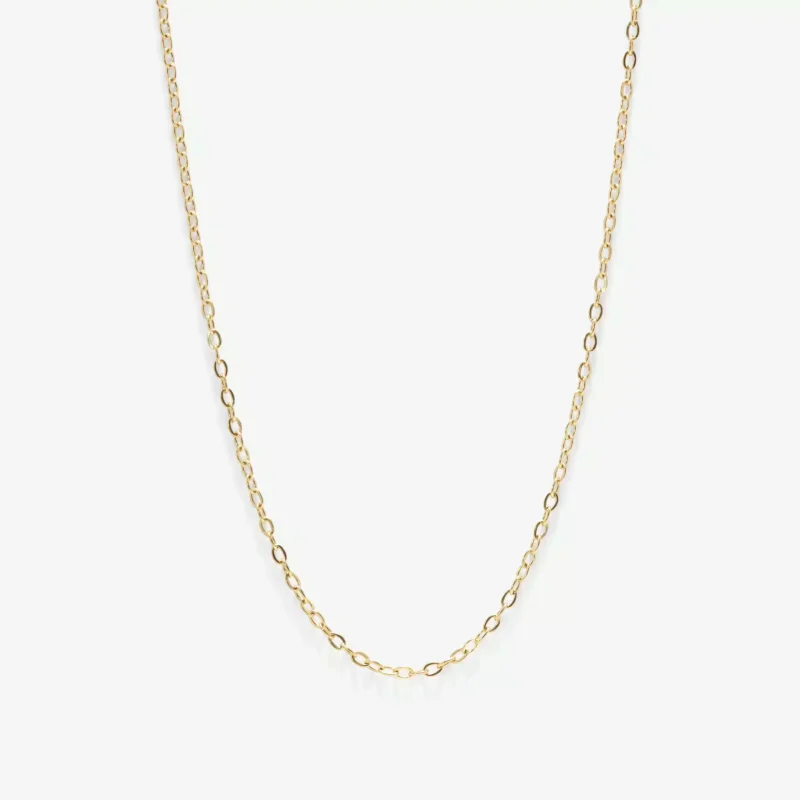
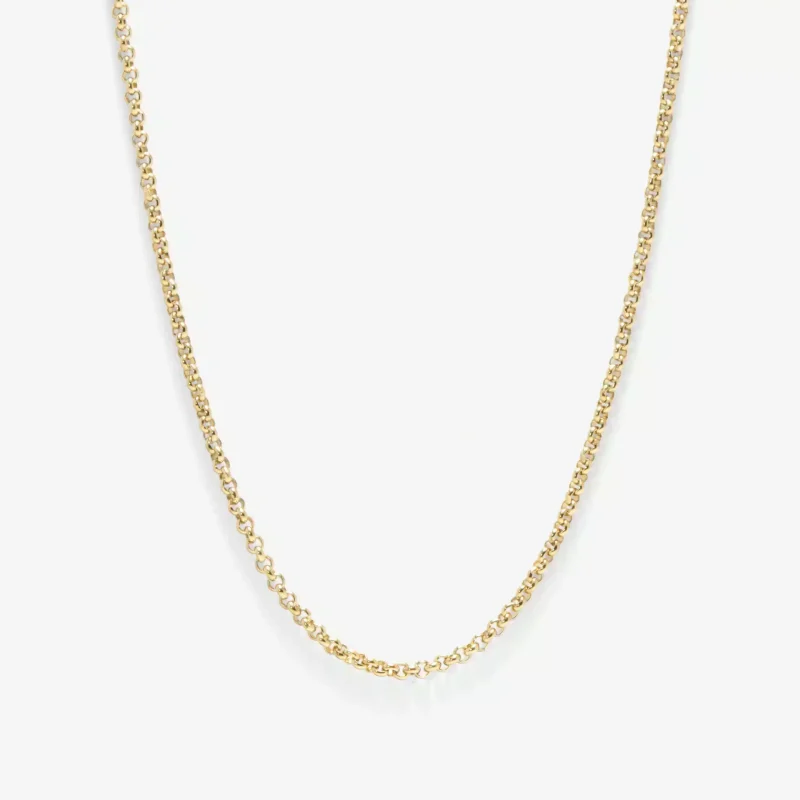
Knowing the length you want makes choosing a chain simpler. The Dainty Chain is a fine everyday style that sits well at a standard princess length, while the Rolo Chain has a slightly heavier round-link look that holds its shape when measured and worn. Both are made from recycled stainless steel with a 14k gold PVD coating, so they are waterproof and keep their colour with daily wear. For where each size sits on the body, see our necklace length guide, and once you have your measurements, read how to layer necklaces without overdoing it to plan the spacing between chains.