

You go to put on the necklace you wore yesterday and find it has tied itself into a knot overnight, somehow, in a closed drawer, all on its own. Ten minutes of squinting and a stray pin later, you give up and wear something else. If that scene feels familiar, you are in good company, and the reason behind it is simpler than it seems.
So why does my necklace tangle? Chains knot for two reasons: movement and loose storage. A necklace left undone and free to slide around will shift every time the drawer opens or the bag moves, and that motion is what works the links into a knot. Fix the storage and you fix most of the tangling. The rest is about how you handle layered pieces and which chains you reach for.
Why does my necklace tangle in the first place?
A fine chain is made of many small links that can move in any direction, so the moment one end slips through a loop, a knot begins. All it takes is a little movement and an open clasp for that to happen, again and again, until the chain is in a tangle. The finer and longer the chain, the more freely it moves and the more readily it knots.
The two culprits are movement and loose storage. A necklace lying free in a drawer, tossed in a pouch with others or dropped into a handbag has both: it can slide around, and its open clasp gives the chain an end to thread through itself. Remove either one and tangling becomes far less likely. Remove both and it nearly stops altogether, which is the aim.
How does doing up the clasp stop tangles?
Fastening the clasp turns a loose chain into a closed loop. A closed loop has no free end to slip through a gap, so even if it shifts a little it has nothing to knot around. This one habit does more to prevent tangles than anything else, and it takes about a second to do.
Get into the routine of clasping each necklace as you take it off, before it goes away. It is the difference between a chain that comes out ready to wear and one that needs unpicking before you can leave the house. Pair clasping with proper storage and tangles all but disappear from your morning. If you wear a pendant, fastening the clasp also keeps the pendant from sliding to the end of the chain and weighing one side down.
What is the best way to store necklaces?
Once a necklace is clasped, the aim is to stop it moving against other pieces. The two reliable methods are storing each one flat with room around it, or hanging it so it falls straight. Both keep chains separated and still, which is what knot-free storage comes down to.
Hooks on a wall or a stand let necklaces hang without touching, which suits longer chains especially well and turns your favourites into something you can see and reach easily. A divided tray or individual pouches work for flat storage and for travel, giving each piece its own space so nothing slides into anything else.
The principle is one piece, one spot, so nothing can wind around anything else. When you travel, a pouch or a small case with separate slots keeps the same rule going on the move, which is when chains tend to tangle most. Our guide on how to store jewellery you wear often covers the setups in more detail.
If you keep necklaces in a jewellery box, look for one with individual compartments or a row of small hooks inside the lid, so pieces stay apart instead of settling into the same corner. The few pounds a divided box or a simple stand costs tends to pay for itself in chains you do not have to rescue, and in the fine pieces it keeps from snapping. Whatever you use, the test is the same: can each necklace hang or lie without touching another? If yes, knots have nowhere to start.
How do you stop layered necklaces tangling?
Layering is where tangles love to happen, because several chains share the same space and move together all day, brushing against one another with every turn of the head. The trick is spacing: choose lengths that sit a couple of inches apart so each chain rests at a different point and has less chance to cross the others.
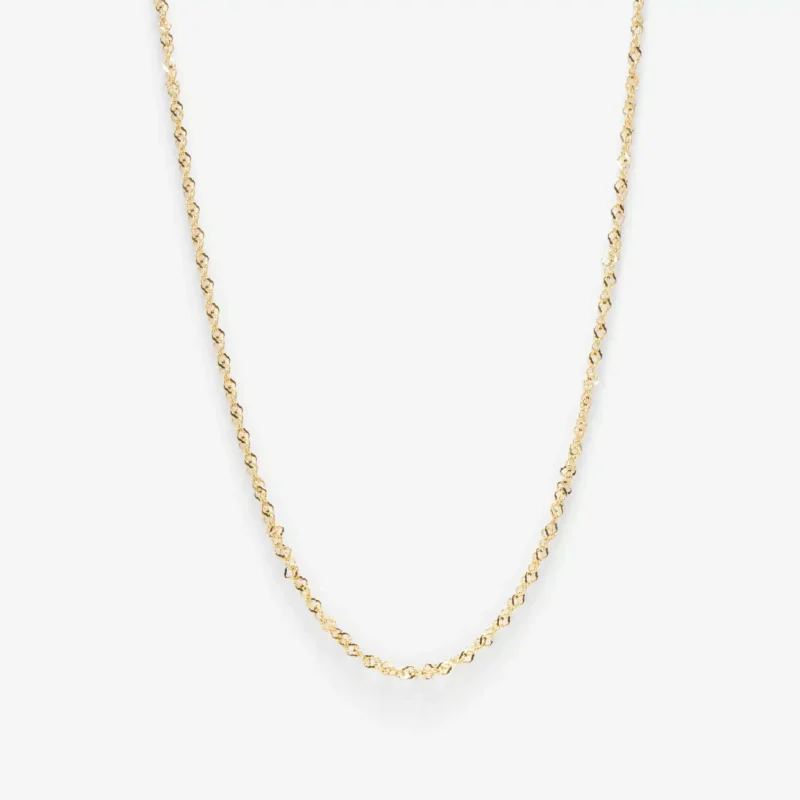
Different chain styles help too. A chain with a little texture or weight, like a twisted style, tends to sit more firmly than a very fine one, so it slides around less through the day. When you take a layered look off, unclip the pieces and store them separately, so the whole bundle does not drop into a drawer to knot overnight. For building a stack that behaves, see our guide on how to layer necklaces without overdoing it.
Does the type of chain affect tangling?
It does. Very fine, lightweight chains move the most and knot the most easily, simply because they have the least to hold them in place. Chains with more structure or a twisted construction hold their shape better and tend to tangle less in storage and in wear, which is worth knowing if knots drive you to distraction.
That said, even the finest chain stays knot-free with the right habits. Clasp it, store it flat or hung, and keep layered pieces spaced and separated when they come off. The chain style changes how often you need to think about it, while the storage habit is what really keeps knots away. If you love a delicate look, you can have it without the daily battle, as long as the storage is sorted.
How do you untangle a necklace without damaging it?
Even with good habits, the odd knot still happens, and how you tackle it decides whether the chain survives. Work in good light on a flat surface, and resist the urge to pull, since tension is what kinks and snaps a fine chain. Lay the necklace down, loosen the knot gently, and use a pin to ease the loops apart, with no tugging at the ends.
A drop of baby oil or a little talc on the knot helps the links slide past each other, which makes a stubborn tangle far easier to coax open. Once it is free, wipe the chain clean with a soft cloth, clasp it, and put it away properly so the same knot does not greet you tomorrow. Patience does more here than force ever will.
Frequently asked questions
Why does my necklace keep knotting on its own?
Chains knot because of movement and loose storage. A necklace left undone and free to slide shifts every time a drawer or bag moves, and its open clasp gives the chain an end to thread through itself.
How do I stop my necklace from tangling?
Do up the clasp before you put it away, then store it flat with room around it or hang it so it falls straight. A closed loop with nothing to rub against has little chance to knot.
Should you clasp a necklace before storing it?
Yes. Fastening the clasp turns the chain into a closed loop with no free end to slip through a gap, which is the single most effective way to prevent tangles.
How do you keep layered necklaces from tangling?
Choose lengths that sit a couple of inches apart so each chain rests at a different point, and unclip them to store separately, keeping each piece on its own when you take the look off.
Do some chains tangle less than others?
Yes. Very fine, lightweight chains move and knot the most, while chains with more structure or a twisted construction hold their shape and tangle less. Good storage keeps any chain knot-free.
Related pieces
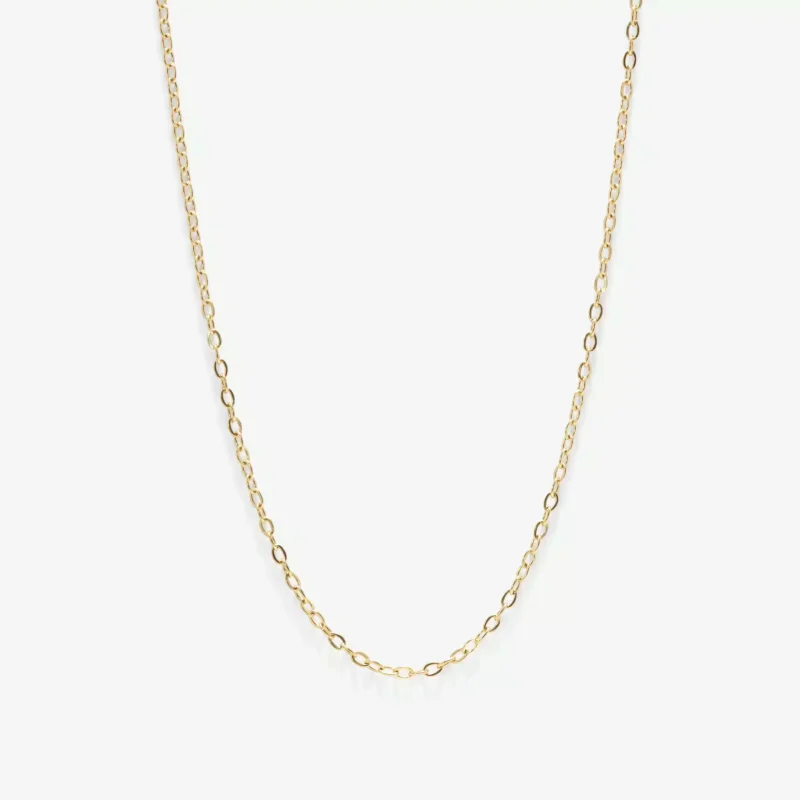
For an everyday chain that stays easy to wear, the Dainty Chain sits neatly at the collarbone, and the Singapore Twist Chain adds a little texture that helps it hold its shape when you layer. Both are made for daily life in waterproof, tarnish-free 14k gold PVD over recycled stainless steel, ready for the shower, the gym and a swim with a quick rinse and dry.