

You have probably seen the term on a product page, sitting next to a chain you liked, and wondered whether it was a quality marker or a bit of jargon. So what is PVD jewellery, in plain English? PVD jewellery is jewellery finished with a coating applied by physical vapour deposition, a vacuum process that bonds a gold-toned layer onto a base metal at a molecular level. The result is a hard, integrated surface that holds its colour far longer than ordinary plating, which is why so much everyday jewellery now uses it.
What PVD means in jewellery
PVD stands for physical vapour deposition. It is a method of coating a piece of jewellery with a thin layer of metal inside a sealed vacuum chamber. The coating material is turned into a vapour, and the metal particles then settle onto the surface of the piece and bond with it.
The phrase "PVD plated" describes that finished result: a base metal, usually stainless steel, carrying a vapour-deposited coating in a gold or silver tone. When you read "PVD coating" on a product page, it refers to this bonded surface layer. The coating is thin, often between 0.5 and 5 microns, yet it sits on the metal as a dense, even film.
In short, the term tells you two things: how the colour was applied, and roughly how it will behave. A vapour-deposited finish is built to stay put through regular handling.
How the PVD coating process works
The process starts in a vacuum chamber. The jewellery is cleaned, mounted on a fixture, and the air is drawn out until the chamber reaches a high vacuum. A target made of the coating metal, such as titanium or chromium, is then bombarded with heat, an electric arc, or charged particles. This releases metal atoms, which travel through the empty chamber and condense onto the jewellery as a solid film.
Because the atoms arrive with energy and pack tightly, they intermix with the top atoms of the base metal. That creates a true metallurgical bond, so the coating reads as part of the surface. By controlling temperature, pressure and power, the coating goes on at a consistent thickness across the batch. A typical run takes minutes to a few hours.
Most jewellery PVD coatings are compounds, not pure metals. Titanium nitride gives a warm gold tone, zirconium nitride gives a cooler gold, and chromium nitride reads as silver. These compounds have tightly packed crystal structures, which is part of why the finish is so hard.
The vacuum is doing important work here. With the air removed, the metal atoms travel in straight lines and arrive clean, so the film forms with very few gaps. That density is why a coating just a micron or two thick can stand up to years of handling. For a sense of scale, a human hair is around 75 microns across, many times thicker than the coating itself, and the coating still wears the way the solid metal beneath it does.
How PVD coating differs from electroplating
Electroplating and PVD both put a thin metallic layer on a base metal, and they hold on in different ways. Electroplating uses an electric current to draw gold ions out of a solution and onto the surface. The layer is soft and held mainly by surface adhesion, so it can flake or wear through at edges and contact points. Once it breaks, the base metal underneath is exposed and can discolour.
PVD bonds into the surface at a molecular level, so the coating behaves like part of the metal. Hardness is the clearest measure of the gap. Electroplated gold sits at roughly 150 to 250 Vickers, while PVD coatings reach far higher, often well into the thousands. That hardness means a PVD finish resists scratches and rubbing much better. A gold-plated chain worn every day can show wear within months, while a PVD-coated piece of similar design stays looking new for far longer. For a fuller side-by-side, see our guide on PVD vs gold plating.
Is PVD jewellery good, and how long does it last?
PVD jewellery is a good choice for pieces you wear often, because the finish is built to last. On stainless steel, a quality PVD coating typically holds its colour for around two to five years of daily wear, and longer when a piece is worn occasionally or looked after. By comparison, standard electroplating can wear thin within months of regular use.
The base metal matters as much as the coating. Stainless steel is hard and resists corrosion, so even a small scratch through the coating leaves a surface that stays wearable. A cheaper copper-alloy base will start to discolour the moment the coating is breached, which is why PVD on stainless steel lasts so well. Quality and care still affect the outcome, and for everyday wear the combination of a stainless base and a vapour-deposited finish is one of the more reliable options available.
Because the finish stands up to moisture and friction, PVD-coated jewellery suits swimming, exercise, and work that is hard on the hands. If you want jewellery you can leave on, look at waterproof everyday jewellery built on this kind of finish.
It is worth setting expectations honestly. "Good quality" here means a finish that keeps its colour and resists everyday wear, while still being a piece that can be damaged. A sharp knock or a deliberate scrape can still mark any coating. What PVD gives you is a surface that holds up to the ordinary demands of being worn every day, which is exactly what most people are asking of a chain or a pair of earrings.
What to keep in mind before buying
PVD has a few practical limits worth knowing. Very elaborate shapes with deep recesses or fine filigree can be hard to coat evenly, because the atoms travel from one direction and reach exposed surfaces best. The coating is also a permanent finish: if a deep scratch or knock cuts through it, the piece would need to go back to a coating facility to be redone, which is rarely practical. Colour options are narrower than electroplating, since each tone comes from a specific compound.
Care is simple, and it helps the finish go the distance. Wipe a piece with a soft cloth now and then to lift off sweat and product, and store items so they do not knock against each other. There is no need to keep PVD-coated stainless steel away from water, since the finish is built to handle it, though drying a piece after a swim keeps it looking its best.
None of these limits counts against PVD for the everyday pieces most people buy. A simple chain, a pair of hoops, or a fine bracelet in PVD-coated stainless steel gives you a finish that keeps its colour, shrugs off water, and asks very little of you. For frequent wear, that is the point of choosing it.
FAQ
What does PVD mean in jewellery?
PVD means physical vapour deposition, a vacuum process that applies a thin metallic coating to a base metal. In jewellery it describes a gold or silver toned surface bonded onto the metal, usually stainless steel.
Is PVD jewellery good quality?
Yes, for everyday wear. The coating is much harder than electroplated gold and resists scratches, water and sweat, so the colour lasts for years, where ordinary plating fades within months. The quality of the base metal and basic care still affect how well it holds up.
What does PVD plated mean?
PVD plated means the piece has been coated using physical vapour deposition. The finish is bonded into the surface at a molecular level, which makes it harder and more durable than ordinary plating.
Does PVD coating wear off?
It can wear eventually, but very slowly. On stainless steel, a good PVD coating usually keeps its finish for about two to five years of daily wear, and longer with occasional wear and simple care.
Related pieces
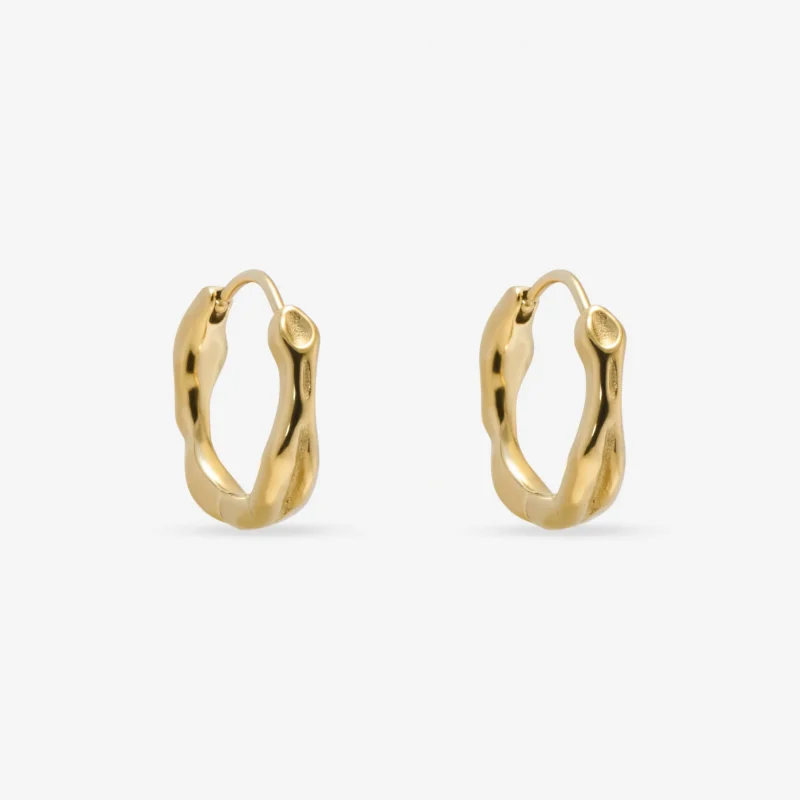
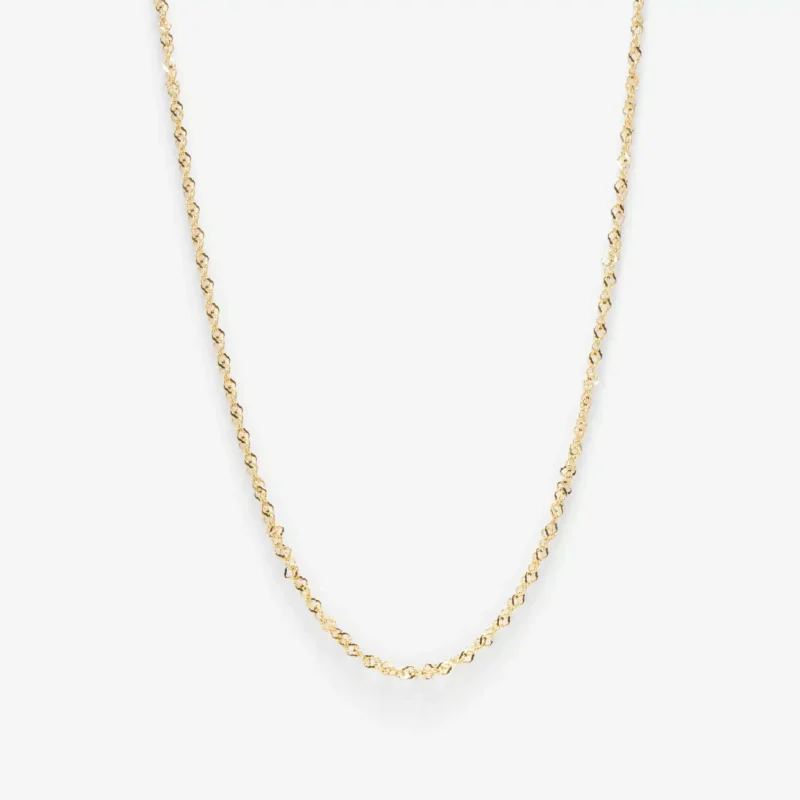
For pieces that put this finish to work, the Molten Hoop Earrings and the Singapore Twist Chain are made from recycled stainless steel with a 14k gold PVD coating, so they hold their colour through water, sweat and daily handling. Both are designed as everyday pieces you can put on and forget about.