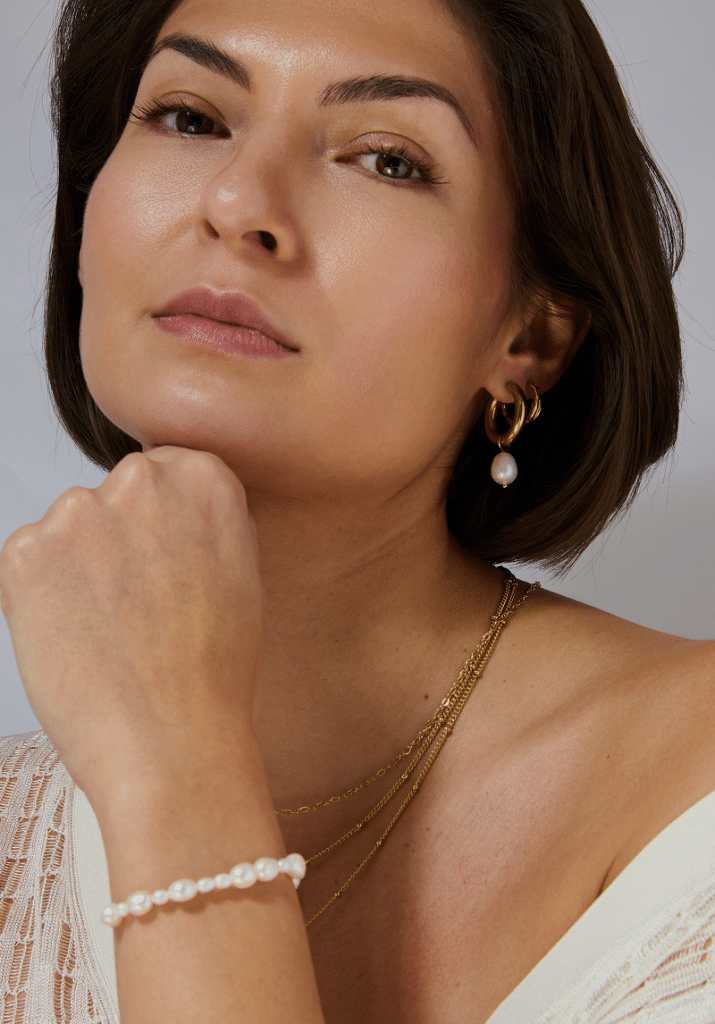


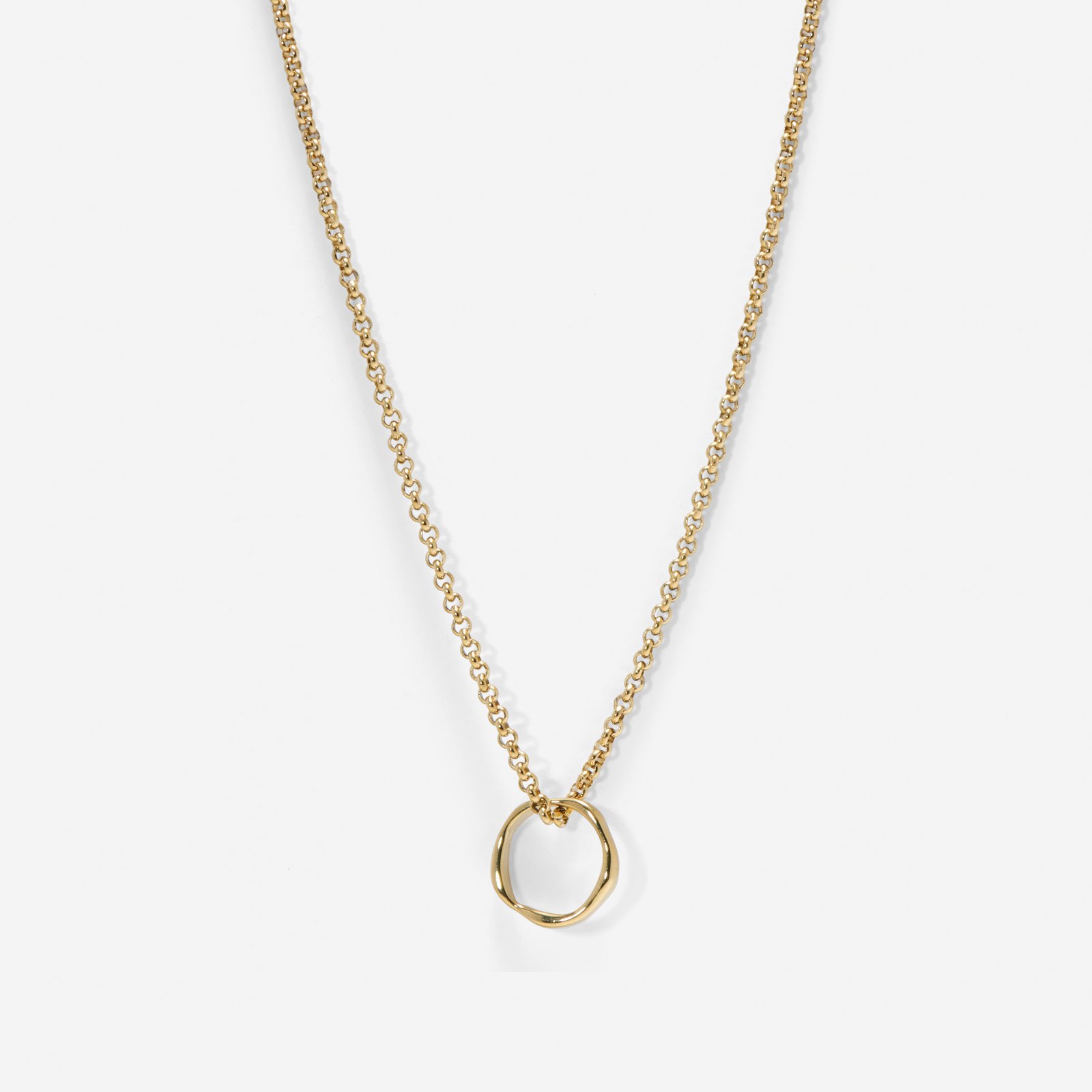
There is a small hesitation that comes with choosing a letter to wear at your throat. Yours, or theirs? It is the kind of question people turn over for longer than you might expect. The reassuring answer is that whose initial you wear on a necklace is entirely yours to decide, and both choices are common and correct. Wearing your own letter is the most popular, read as a quiet form of self-recognition. Wearing another person's initial, a partner, a child, a parent, a sibling, or someone you have lost, marks a relationship you want to carry with you. There is no single rule. The right answer is the letter that means the most to you, and the two choices simply do different emotional work.
Whose initial do you wear on a necklace?
Most people wear their own. It is the default, and the most straightforward: the letter refers back to you, marks the piece as yours, and tends to feel private even when others can see it. Wearing your own initial is read as a small statement of self. Your name is your identity, and carrying it is a steady form of self-recognition.
The other common choice is to wear the initial of someone close. A partner, a child, a parent, a sibling, a friend, or someone who has died. Some people wear two letters together, their own beside a loved one's, so the piece holds both self and connection at once. Each of these is a valid way to wear an initial necklace. The decision rests on what you want the piece to hold.
What does wearing your own initial say?
Wearing your own initial is self-directed. The personalisation points back at you: you are both the wearer and the person the letter represents. To anyone looking, it reads as a plain statement of self, a mark that this object belongs to and stands for this particular person.
It has a private side too. In quiet moments, when you look at or touch the piece, you meet a familiar form, your own letter. The necklace offers visibility towards others and intimacy towards you at the same time. Owning an object marked with your own initial tends to create a stronger sense of attachment than an unmarked equivalent, because the personalisation reinforces the link between you and the piece. For some wearers this clarity feels affirming. For others it can feel a touch obvious, since they are always aware of exactly what the letter refers to.
What does wearing someone else's initial mean?
When you wear another person's initial, the emotional register shifts and the focus moves outward. The piece becomes a form of connection to that person. The letter still stands for identity, though not your own, and the work the piece does is relational. You touch it as a reminder of someone else.
The weight of that depends on the relationship and on how the piece came to you. An initial given by someone close can feel like an ongoing presence. One chosen to mark a relationship can feel like a quiet acknowledgement of priority. An initial inherited from someone no longer living carries a different quality again, blending the relationship with memory and continuity. Objects that stand for important relationships tend to gather emotional charge over time, as the wearer's memories and feelings collect around them.
An other-directed initial also asks a little more of the wearer. A piece marked with your own letter folds into your sense of self almost on its own, through wear and through your own life events. A piece marked with someone else's keeps its meaning through the history of the relationship and through the moments you have worn it while thinking of that person. That ongoing connection is part of why a loved one's initial can become one of the pieces people are least willing to part with.
There is a social dimension as well. Wearing someone else's initial can quietly signal to others that you hold particular bonds, or it can stay known only to those close to you. The piece allows both readings, which is part of why it suits private meaning so well.
Is wearing your own initial considered vain?
No. The idea that wearing your own letter is self-promoting misreads what the piece does. An initial necklace is usually worn for the wearer, with the audience an afterthought. Most people choose it for personal meaning, the impression it creates a distant second, and the letter often sits small and close to the body where few look closely enough to read it.
It helps to remember that identity forms in relation to others as much as in isolation. Wearing your own initial can be a way of honouring your own continuity through changing circumstances. Wearing someone else's can be a way of claiming connection to that person as part of who you are. In principle, both are equally personal, simply in different registers. The vanity reading only holds if you assume the piece is aimed outward, and for most wearers it points inward.
Is there an etiquette to initial necklaces?
Initial necklace etiquette is light. There are no firm rules about which letter you may wear, and you owe nobody an explanation of what it stands for. The meaning belongs to you, disclosed or kept private as you choose. A few practical conventions do help, though.
If the piece is a gift, the giver usually selects an initial that reflects genuine knowledge of the recipient: the right person, the right relationship, the form they would actually wear. A personalised gift tends to land better when the personalisation shows real attention. When you wear more than one letter, a clear visual hierarchy keeps the meaning readable: your own initial on one chain, a loved one's on another, worn at different lengths so each has room. And the letter need never be visible at all. An initial worn against the skin, on the inside of a pendant, is a private mark the piece keeps for you alone.
How do you decide which initial is right for you?
Start with what you want the piece to do. In periods of change or self-definition, your own initial often holds more appeal, working as a small daily anchor for your sense of self. In settled periods with strong relationships, someone else's letter may feel more fitting, keeping a central bond close. Many people move between the two over the years, choosing by genuine current priority more than by habit, and that renewed choice becomes its own form of expression.
You can also combine them. Layering your own initial with a loved one's makes a piece that performs both self-reference and connection, a small statement about identity formed in relation to the people who matter. If you are unsure, begin with the letter you would least want to be without, and let the collection grow from there as relationships and moments accumulate.
One thing worth keeping in mind is that the choice can shift over a lifetime while the object stays the same. Unlike clothing or a hairstyle, an initial piece can alter its reference and its significance as your life and priorities move. The same necklace can read as self-affirmation in one season and as a held bond in another, depending on which letter feels most central. That flexibility is part of what makes initial jewellery distinctive, and it is why there is no need to settle the question once and for all when you first buy a piece.
Frequently asked questions
Should I wear my own initial or my partner's?
Either is correct. Your own initial reads as self-recognition; your partner's marks the relationship. Some people wear both letters together. Choose the one that means the most to you at this point in your life.
Is it weird to wear your own initial?
No. It is the most common way to wear an initial necklace and is read as quiet self-identity, especially when the letter is small and worn close to the body.
Can you wear more than one initial at once?
Yes. Layering two or more letters at different lengths is common and lets a single look hold several relationships. Keep a clear hierarchy so each letter has visual room.
Whose initial do couples usually wear?
There is no fixed convention. Some wear their partner's initial as a romantic gesture, some wear their own, and some wear both letters together. The choice is personal, and etiquette does not dictate it.
Related pieces
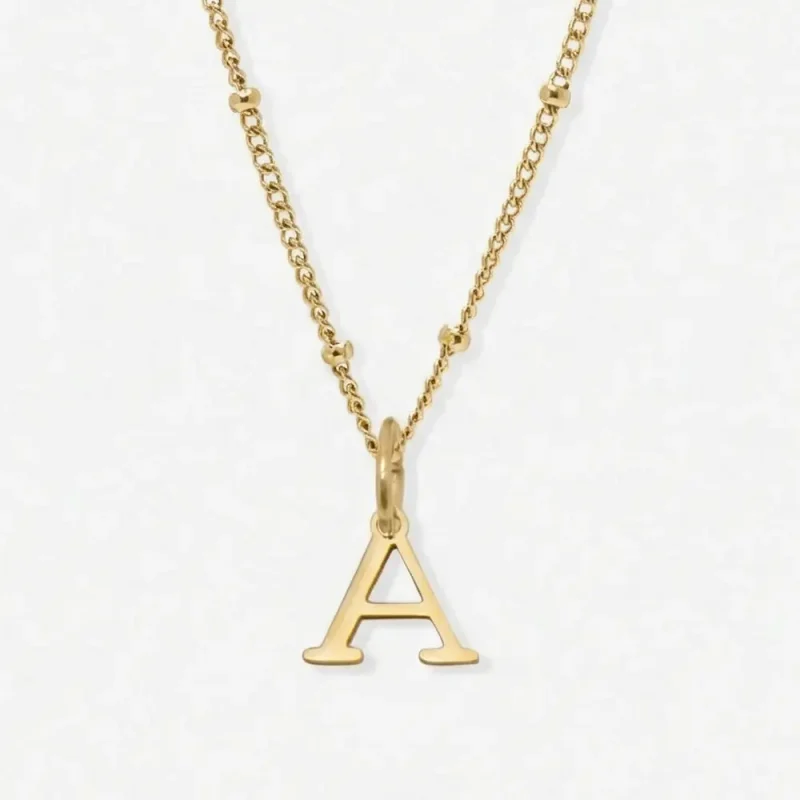
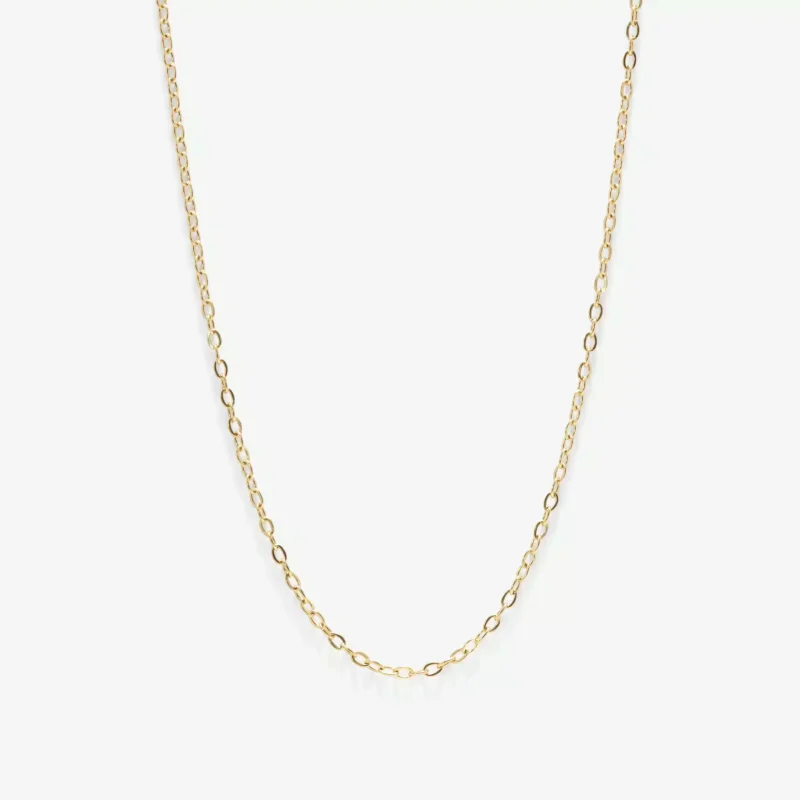
An Alphabet Necklace renders a single chosen letter, your own or someone else's, in recycled stainless steel with a 14k gold PVD coating, waterproof and tarnish-free for daily wear. A Dainty Chain gives a fine, understated base for layering more than one initial at different lengths. For the meaning behind the letter, read what an initial necklace means, and for styling, see how to wear an initial necklace.