

There is a particular moment when you turn a piece over, looking for some tiny clue that tells you what you actually own. Maybe it was a gift, an inheritance, or a bargain that felt too good to be true. The marks are small and the questions are big, so it helps to know exactly where to look.
To tell if jewellery is real gold, start with the hallmark or carat stamp, then weigh it in your hand, check the colour for consistency, and try a magnet, since solid gold is not magnetic. These home checks point you in the right direction, and a jeweller can confirm it for certain when the answer really matters.
What does the hallmark or carat stamp tell you?
The hallmark is the first and most useful check. Solid gold is usually stamped with a carat mark that shows its purity, often as a three-digit number: 375 means 9 carat, 585 means 14 carat, and 750 means 18 carat. You will usually find it on the clasp of a necklace or bracelet, or the post of an earring, and a magnifying glass helps with the smallest stamps.
A genuine hallmark is a strong sign the piece is solid gold and not plated, because plated items are seldom stamped this way and may instead carry marks like GP for gold plated or GF for gold filled. If you see a clear carat stamp, it tells you both that the gold is real and how pure it is. No stamp at all is not proof of a fake, but it does mean you should lean harder on the other checks below.
Is real gold magnetic?
Solid gold is not magnetic, which makes a simple magnet one of the quickest checks you can do at home. Hold a reasonably strong magnet close to the piece: if it pulls towards the magnet or sticks, there is a magnetic metal inside, so it is not solid gold. Real gold will show no attraction at all.
Treat this as a useful screen, not the final word. A piece can pass the magnet test and still be gold plated over a non-magnetic base such as brass, so a negative result rules out some fakes without proving the whole piece is solid gold. Use it alongside the hallmark and the weight, where it earns its place as a fast first filter before you look more closely.
What can weight and colour reveal?
Gold is dense, so weight is a quiet but honest clue. Solid gold has a noticeable heft for its size, while many plated or hollow pieces feel surprisingly light for how they look. If a piece seems too light for a metal that should feel substantial, that is worth noting against your other checks.
Colour and consistency matter too. Solid gold keeps an even colour all the way through and across the whole piece. Plated jewellery tends to wear at the edges and high-contact points, where a different colour of base metal starts to show through over time. Look closely at clasp edges, the backs of pendants and the insides of bangles, since that is where worn plating gives itself away first. A patch of silvery or coppery colour peeking through gold is a clear sign of plating. Bear in mind that colour alone can mislead, since a good plated piece looks identical to solid gold when new, so always read colour together with the hallmark, the weight and the magnet test before you decide.
How is real gold different from plated, vermeil and gold-filled?
Knowing the categories helps you read what you are holding. Solid gold is gold all the way through at its stated carat. Gold plated has a thin layer of gold over a base metal, which is why it wears at the edges. Gold vermeil is a thicker layer of gold over solid silver, and gold filled has a bonded layer that is thicker again than standard plating.
These differences explain why two gold-coloured pieces can feel and age so differently. A solid piece keeps its colour throughout, while plated and vermeil pieces depend on how thick that gold layer is and how it has been applied. For everyday jewellery, a durable sealed finish such as PVD-coated stainless steel is a separate route again, designed to hold its colour without being solid gold at all, which is why it suits pieces you wear hard.
When should you ask a jeweller to test it?
The home checks narrow things down, but a jeweller can give you a definite answer. If a piece is unmarked, valuable to you, or you simply want to be sure, a professional can test it properly. Common methods include an acid test on a tiny sample and electronic testing that reads the metal without damage.
It is worth asking when the stakes are real: before selling an inheritance, insuring a piece, or buying something secondhand at a meaningful price. A jeweller can also confirm the carat and spot good-quality plating that might fool a quick glance. For everyday fashion pieces that you bought new from a clear seller, the materials information usually tells you what you need to know already, so you can save the visit for the pieces that matter.
What mistakes catch people out?
A few common slips lead people to the wrong conclusion. Trusting colour alone is the biggest, since good plating can look identical to solid gold until it wears. Reading a maker stamp or a brand initial as a carat mark is another, because those letters say who made a piece, not what it is made from. And assuming an old or heavy piece must be solid gold ignores how convincing plated and gold-filled items can be.
The fix is to use more than one check together. A clear carat stamp, a non-magnetic result, a fair weight for the size and an even colour with no wear at the edges point the same way when a piece is solid gold. If the signs disagree, that is your cue to ask a jeweller before you buy, sell or insure. Treating any single test as proof is what catches people out most often.
Frequently asked questions
How can I tell if jewellery is real gold at home?
Check for a hallmark or carat stamp such as 375, 585 or 750, weigh it in your hand, look for consistent colour, and try a magnet, since solid gold is not magnetic. A jeweller can confirm it for certain.
What do 375, 585 and 750 mean on gold?
They are carat marks showing purity: 375 is 9 carat, 585 is 14 carat, and 750 is 18 carat. A clear carat stamp is a strong sign the piece is solid gold and not plated.
Is real gold magnetic?
No. Solid gold is not magnetic, so if a piece is drawn to a magnet it is not solid gold. A non-magnetic piece can still be plated over a non-magnetic base, so use the magnet alongside other checks.
Does real gold wear off?
Solid gold keeps its colour throughout and does not wear away to reveal another metal. Plated pieces wear at the edges and high-contact points, where the base metal starts to show through over time.
Is gold-plated jewellery worth buying?
It can be, if the base is a stable metal and the finish is durable. A PVD-coated stainless steel piece holds its gold colour well, which suits jewellery you wear every day without the care solid gold demands.
Related pieces
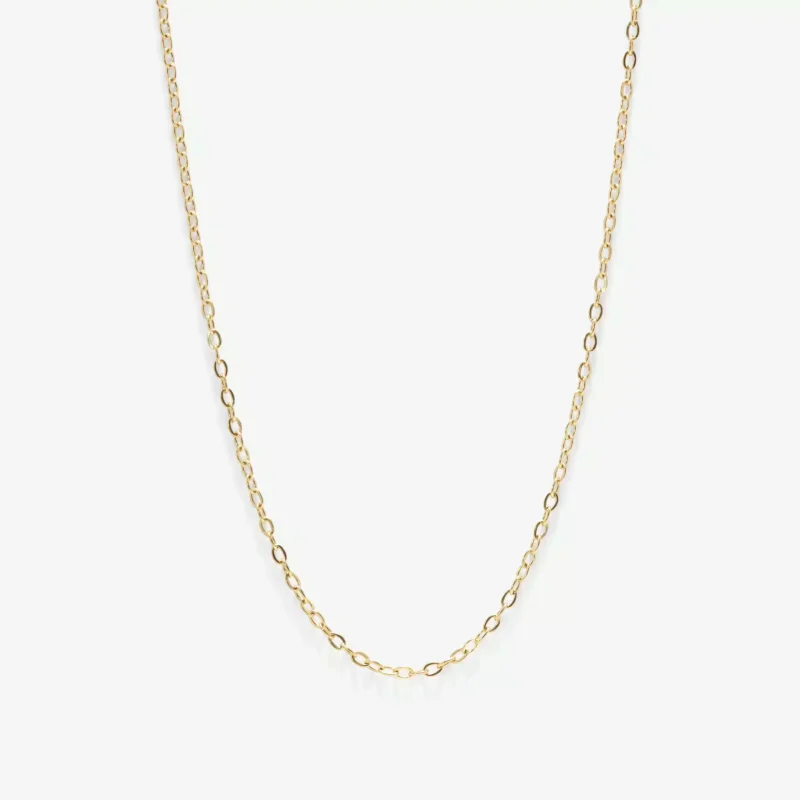
If your aim is the gold look that holds up to daily life, without the care that solid gold demands, the best sellers are a good place to start, since they are the pieces people wear day in, day out. The Dainty Chain shows the approach: recycled stainless steel finished with a 14k gold PVD coating, waterproof, tarnish-free and hypoallergenic, so it keeps its even gold colour through showers and long days without the worry that comes with thinly plated pieces.