

The pieces we love most are the ones we stop noticing. The chain that goes in the shower, the bangle that survives a thousand cuff-snags, the earrings worn through gym and grocery run alike. That quiet reliability is what durable jewellery is really about. It comes from a hard, corrosion-resistant base metal paired with a finish that bonds to it and a construction sound enough to take constant stress. Worn every day, a piece meets moisture, friction, skin chemistry and small impacts hundreds of times, and the materials that handle this well are chosen for exactly that. What follows is what daily wear demands, which materials hold up, and how to pick everyday jewellery that keeps its look.
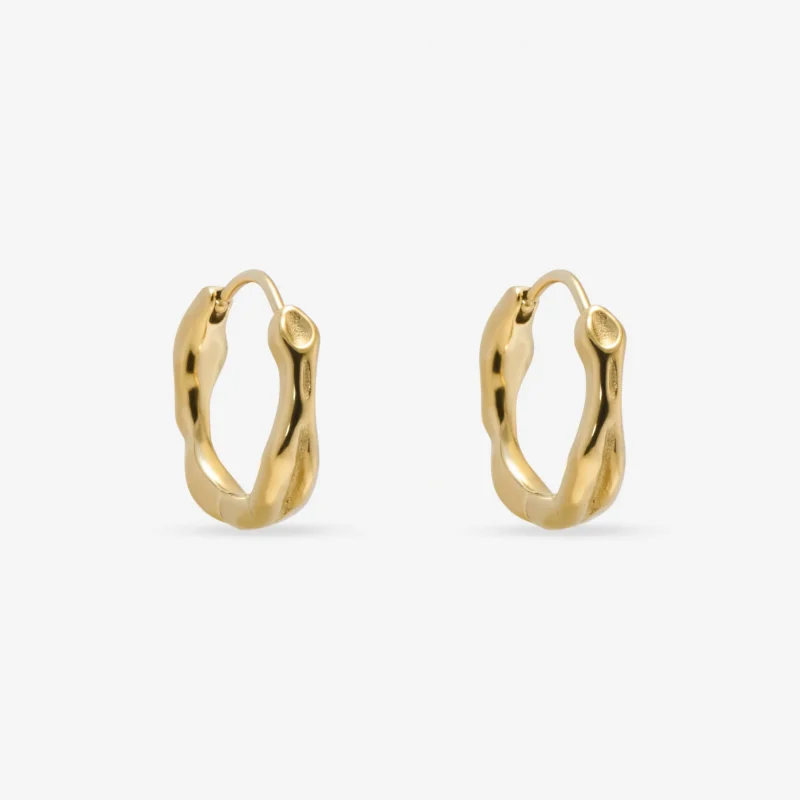
What does everyday wear actually put jewellery through?
A piece worn daily sits in a far harder environment than one kept for special occasions. It stays in contact with skin, sweat and clothing, and meets temperature changes, humidity, and the chemicals in skincare and cleaning products. None of these is extreme on its own. Across weeks and months they add up, and that cumulative load is what separates materials that last from materials that look the part and then fail.
Friction is the most constant force. A necklace rubs against the neck and collar, a bracelet against the wrist and cuff, and this slow abrasion polishes away finishes and, in time, wears through thin plating. Flexion adds to it: chains and bracelets bend with every movement, and thousands of cycles a week stress the joints, so weak solder points and thin links eventually fatigue and fail. Occasional impacts, a knock or a catch on a bag strap, dent or bend a piece and leave a stress point that fails more easily later.
Two quieter forces work alongside these. Sweat and skin chemistry vary from person to person, so the same metal can discolour quickly on one wearer and stay clean on another, which is part of why some people react to certain pieces and others never do. Temperature swings between indoors and out make metals expand and contract, and where a piece combines materials with different expansion rates the join takes the strain, loosening settings and stressing solder over months and years. A material that handles all of this at once, hardness, corrosion resistance and stability together, is what everyday wear really asks for.
What makes jewellery durable?
Durability rests on surface hardness, resistance to corrosion, and the strength of the joins. Hardness governs how well a surface resists scratching, and it is measured on the Vickers scale. Pure gold sits at roughly 25 to 35 HV and silver in a similar low range, while 316L stainless steel is far harder at around 190 to 210 HV. A soft metal worn against the neck shows scratching within weeks; a harder one shows very little under the same conditions.
Corrosion resistance decides how a material copes with sweat and damp. Gold is almost unaffected by everyday chemicals. Silver reacts with sulphur compounds in air and on skin and tarnishes readily, which cleaning reverses though the tendency stays. Stainless steel forms a thin chromium oxide layer that protects it and reforms when scratched, the passivation that gives it its resilience around water and sweat. The strength of clasps, solder joints and links then decides whether good materials actually hold together under repeated use.
What is the most durable jewellery material?
For everyday wear, stainless steel and PVD-coated stainless steel give the most consistent performance, with solid gold close behind. 316L stainless steel is hard, corrosion-resistant and hypoallergenic, and a piece in it shows little visible change over years of daily wear. PVD coating raises this further: applied to stainless steel, it bonds at a molecular level and reaches a hardness many times that of any metal used in conventional jewellery, so it keeps its surface where softer finishes would show wear in weeks. On stainless steel, a quality PVD finish typically holds for around two to five years of daily wear.
Solid gold stays intact under daily wear in any carat, with 9-carat the hardest and 18-carat softer, and in either case the metal is solid throughout, so any scratches sit in the gold itself and the surface polishes back. With solid gold the colour runs all the way through, which is why it keeps its look where a coating would eventually show wear. Gold-filled, where a thick gold layer is bonded to base metal under heat and pressure, gives a practical middle ground that often stays wearable for ten years or more. Recycled stainless steel with a gold PVD coating brings the colour of gold to a base built for hard wear, which is why it suits pieces meant to be worn through water, sweat and heat. For anyone with reactive skin, hypoallergenic options such as 316L stainless steel are worth checking against a guide to sensitive-skin materials.
Why thin plating fails so quickly
Most affordable jewellery fails at the surface first. Electroplating lays down a very thin layer, often 0.5 to 2 microns, where a human hair is about 70 microns across. That layer gives colour and brief protection, and it wears through at contact points within months of daily wear. Once it breaks, the base metal beneath is exposed: a brass base tarnishes greenish-black in contact with sweat and can mark the skin, and a nickel base can trigger sensitivity in some people.
The timeline depends on how thick the plating is, how hard the metals are, and how hard the piece is worn. A piece worn gently in an office might keep its finish for six months, while the same piece worn during exercise fails faster. A well-bonded coating such as PVD avoids this pattern, because the bond is molecular and the layer is hard enough to resist the abrasion that strips electroplate.
How to choose durable jewellery for the way you live
Match the material to the conditions the piece will actually meet. Someone who swims often needs more corrosion resistance than someone at a desk, and someone who washes their hands constantly should think about how their chosen metal copes with moisture. For most daily routines, solid stainless steel and PVD-coated stainless steel cope best, high-carat gold performs well under moderate conditions and polishes easily, and silver stays a fair choice for anyone happy to maintain it.
Construction deserves the same attention as the metal. Handle the piece before buying: a clasp should engage firmly and hold with real tension, with no need for force and no looseness, and links should move freely yet connect without play. Weight is a fair first guide, since a substantial piece usually carries more material, though the structure should match it, and a delicate chain under a heavy pendant strains at the join over time. A solid base metal, a bonded finish and a precise clasp together make a piece that holds up across years of wear.
It also helps to be honest about how a piece will be stored and combined. Pieces kept loose in a bag or piled together scratch each other, so a hard surface and separate storage both protect the finish. Layering chains of similar hardness keeps softer pieces from being marked by harder ones. A piece chosen for its material and built with a sound clasp will reward this small amount of care with years of steady wear, and a piece chosen on looks alone will show its limits sooner whatever you do.
FAQ
What is the most durable jewellery material?
For everyday wear, stainless steel and PVD-coated stainless steel give the most consistent durability, with solid gold close behind. 316L stainless steel is hard, corrosion-resistant and hypoallergenic, so it shows little change over years of daily use.
What makes jewellery durable?
Surface hardness that resists scratching, corrosion resistance that handles sweat and damp, and strong joins at clasps and links. A hard base metal with a bonded finish and a solid clasp lasts longest.
Is stainless steel jewellery good for everyday wear?
Yes. 316L stainless steel is hard, resists corrosion and tarnish, and is hypoallergenic, so it copes well with water, sweat and friction. A PVD coating adds gold colour while keeping that hard-wearing base.
Why does cheap jewellery tarnish so fast?
It usually uses a thin electroplated finish over a reactive base metal such as brass. The plating wears through within months, the base beneath is exposed, and it tarnishes and can mark the skin.
Related pieces
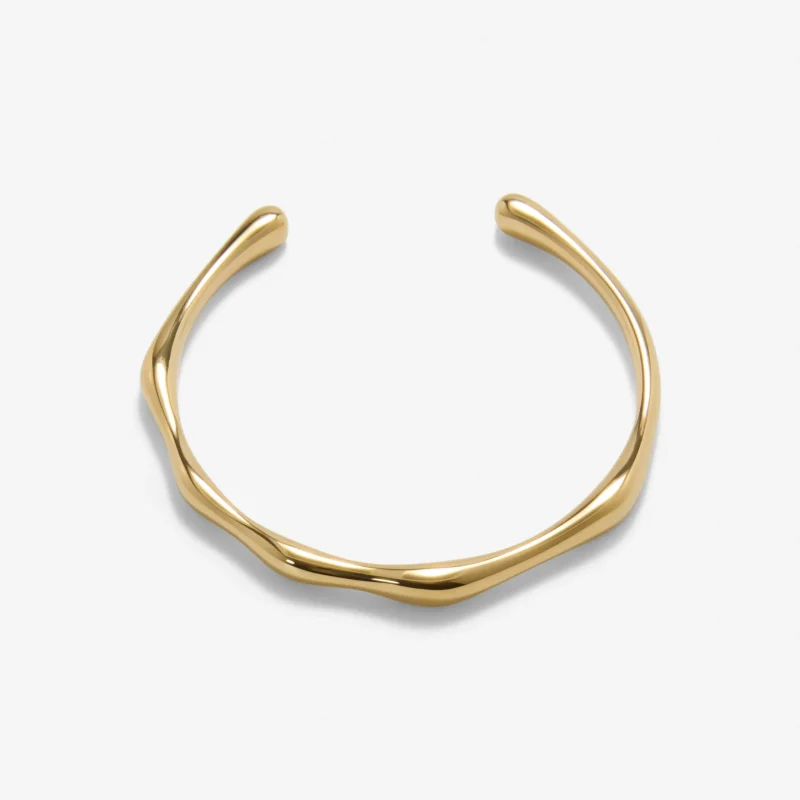
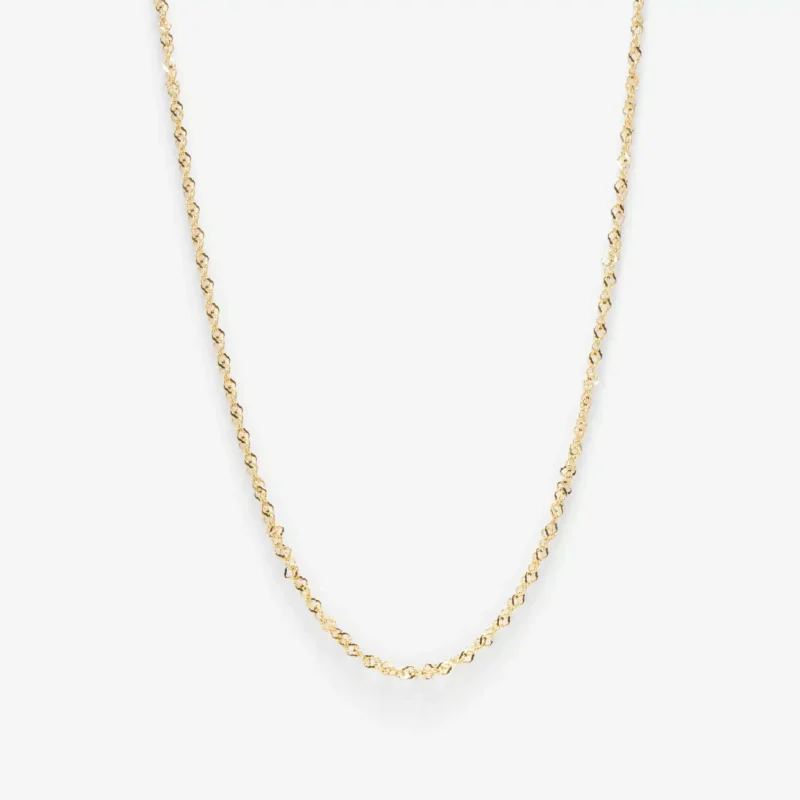
Hard-wearing everyday pieces share a stable base, a bonded finish and a secure clasp. The Molten Bangle and the Singapore Twist Chain are made from recycled stainless steel with a 14k gold PVD coating: skin-friendly, water, sweat and heat resistant, and built to keep their colour through daily wear. Both work as everyday pieces you can put on and forget about.