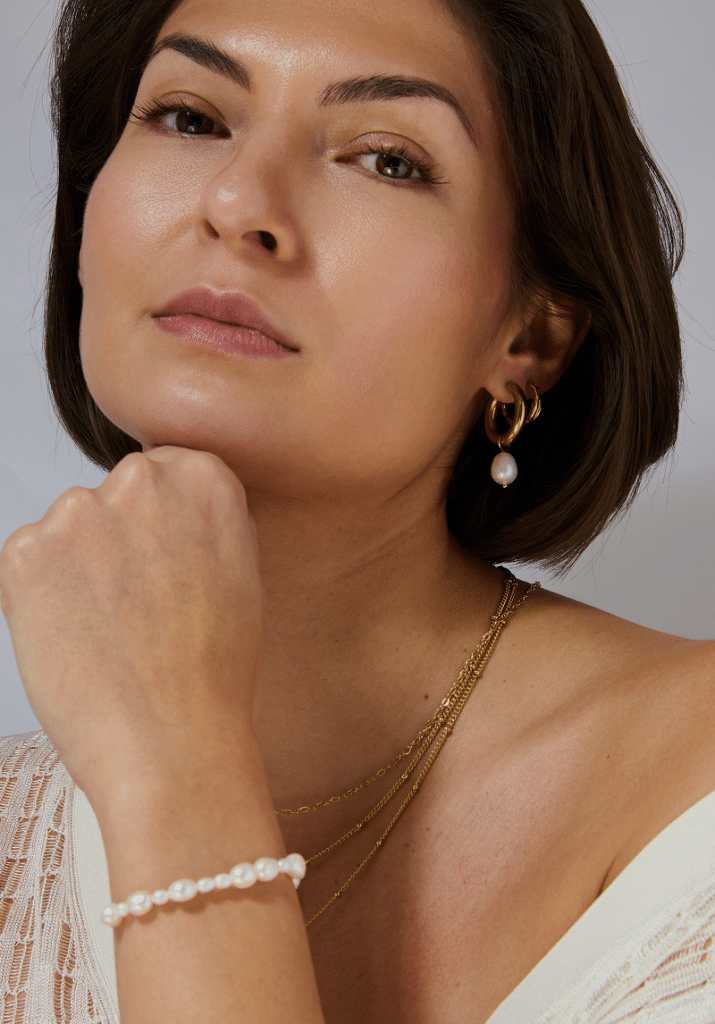


You pull a favourite chain out of the drawer for the first time in a month and it has gone dull, almost grey, while another piece you have worn every day still looks bright. It is a small mystery with a tidy answer. So why does jewellery tarnish on some pieces and never on others? Jewellery tarnishes when a reactive metal in the piece reacts with oxygen or sulphur in the air, on skin, or in cosmetics, forming a dull or dark film on the surface. Silver, copper and brass do this readily. Solid gold, stainless steel and PVD-coated steel mostly do not. The metal decides the outcome, so the chemistry explains the whole pattern.
What causes jewellery to tarnish?
Tarnish is a chemical reaction at the surface of a metal. The atoms on the outside combine with oxygen or sulphur to form a new compound, and that compound reflects light differently from the clean metal beneath it. The result is the darkening or dulling you see on an old silver chain. Tarnish differs from rust, which is the specific reaction of iron with oxygen and water.
How fast this happens comes down to how reactive the metal is. A reactive metal gives up its surface electrons easily, so it forms compounds quickly. A stable metal holds onto its electrons and resists the reaction for years. Silver and copper sit at the reactive end. Gold sits at the stable end. Everything else falls somewhere between, depending on what it is alloyed with.
The everyday triggers are sulphur compounds in the air, oxygen, and the salts and acids in sweat. Perfume, lotion and household cleaning products add more reactive compounds, which is why a piece often dulls faster around the areas that meet skin and spray.
Which metals tarnish, and which resist it?
Silver tarnishes the most. It reacts with sulphur compounds in the air to form silver sulphide, the dark film familiar from neglected silver. Sterling silver, which is 92.5 per cent silver and 7.5 per cent copper, tarnishes predictably, and the copper in the alloy speeds it up. Even fine silver at 99.9 per cent purity tarnishes, just a little more slowly.
Copper and brass tarnish readily too. Copper oxidises to a green patina, and brass, a copper-zinc alloy, behaves much the same way. Both can leave a mark on skin once they start to react. These metals often sit underneath plated jewellery as the base, which matters once the plating wears thin.
Stainless steel resists tarnish strongly. Its chromium content forms a stable, self-repairing oxide layer that seals the surface, a process called passivation. Scratch it, and the layer reforms wherever oxygen reaches it. This is why 316L stainless steel is used for everyday pieces meant to be worn constantly, including in and around water.
Does gold tarnish?
Solid gold does not tarnish under normal conditions, because gold is chemically inert and resists reacting with oxygen and sulphur. A solid gold piece can be worn for decades and keep its colour. This is one of the main reasons gold has been used in jewellery across cultures and centuries.
Carat changes the picture, because most gold jewellery is an alloy. At 18 carat, the piece is 75 per cent gold and keeps most of gold's natural stability. At 9 carat, only 37.5 per cent is gold and the rest is other metals, often including copper, so some 9-carat alloys show mild tarnishing when exposed to sulphur. The higher the gold content, the more inert the piece.
Gold-toned jewellery is a separate case worth knowing. A gold PVD coating on stainless steel gives the look of gold with strong tarnish resistance, because the coating is chemically stable and the steel underneath resists corrosion on its own. A thin gold flash over brass is the opposite. It wears through and the brass beneath begins to react.
Why plated jewellery tarnishes when solid pieces don't
Plated jewellery has a precious-metal surface over a base metal underneath, usually copper, brass or a zinc alloy. While the plating stays intact, it covers the base metal and the piece looks bright. The trouble starts where the plating wears away.
Friction does the wearing. Clasps, the inside of a bangle, the points where a chain rubs, these high-contact areas lose their thin coating first. Once the base metal shows, it oxidises and discolours, and a copper base can leave a green mark on skin. A standard gold flash of around half a micron can wear through within months of daily wear.
Thickness and method change everything here. Gold-filled jewellery uses a much thicker gold layer, often 100 microns or more, so the base stays protected for years. A PVD coating takes a different route again: the layer is bonded to the metal at a molecular level inside a vacuum, forming a hard, integrated surface that resists wear far better than plating. Our piece on PVD explained covers why a bonded layer outlasts a plated one, and the short answer is that it does not simply sit on top waiting to rub off.
How do conditions speed up or slow down tarnish?
Tarnish is a chemical reaction, so the same conditions that speed up any reaction speed up tarnish. Humidity is the main one. Moisture lets ions move across a metal surface more easily, so silver and other reactive metals darken faster in a damp bathroom or a humid climate than they do in dry air.
Air quality plays a part too. Sulphur dioxide from traffic and industry gives reactive metals more sulphur to combine with, so tarnish builds faster in a polluted city than in clean country air. Coastal salt air has a similar effect on corrosion. Temperature adds to it, since warmth pushes the reaction along, which is why a cool, dry drawer is kinder to silver than a warm windowsill.
Body chemistry is the variable people notice most. Sweat is slightly acidic and carries salts and organic compounds, and it sits against a bracelet or chain all day. Some people's skin is more acidic than others, so the same piece can dull quickly on one person and stay bright on another. Perfume, lotion and cosmetics add further reactive compounds to the mix.
How to stop jewellery tarnishing
The most reliable way to stop jewellery tarnishing is to choose metals that resist it: solid high-carat gold, stainless steel, or stainless steel with a PVD coating. These keep their colour with little effort, which makes them well suited to everyday wear. For pieces that do tarnish, the goal is to slow the reaction.
Storage has a large effect on silver and other reactive metals. Air and moisture drive the reaction, so a sealed bag or an airtight box can extend the time before tarnish shows from months to years. Keep these pieces somewhere cool and dry, since heat and humidity both speed the reaction up.
Daily habits help too. Put jewellery on after perfume and lotion, take it off before heavy sweating where you can, and wipe a piece down after wear to remove the salts and acids that build up. For stainless steel and PVD pieces, a quick rinse after the pool or the sea and a soft dry cloth keep the finish bright. If you want the honest meaning behind the labels, our piece on what tarnish-free actually means sets realistic expectations for each material.
FAQ
What causes jewellery to tarnish?
A reactive metal reacting with oxygen or sulphur in the air, on skin, or in cosmetics. The reaction forms a dull or dark film on the surface. Silver, copper and brass react readily, which is why they tarnish.
Does gold tarnish?
Solid gold does not tarnish under normal conditions, because it is chemically inert. Higher carats stay brighter for longer. Lower-carat alloys such as 9 carat contain more reactive metals and can show mild tarnishing.
Which metals tarnish the most?
Silver tarnishes the most, followed by copper and brass. Stainless steel, solid high-carat gold and PVD-coated steel resist tarnish strongly thanks to their stable surfaces.
How do you stop jewellery tarnishing?
Choose tarnish-resistant metals such as stainless steel, PVD-coated steel, or high-carat gold. For reactive metals, store them sealed and dry, keep them away from perfume and lotion, and wipe them after wear.
Why does plated jewellery tarnish faster than solid pieces?
Plating is a thin precious-metal layer over a base metal such as copper or brass. Friction wears it through at clasps and contact points, and the base metal underneath then oxidises and discolours.
Related pieces
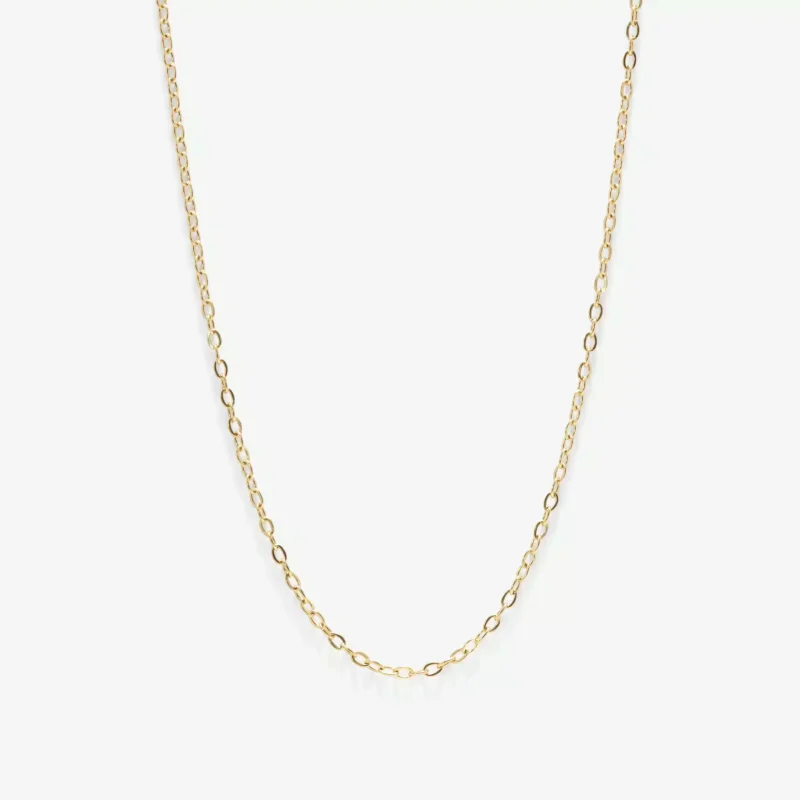
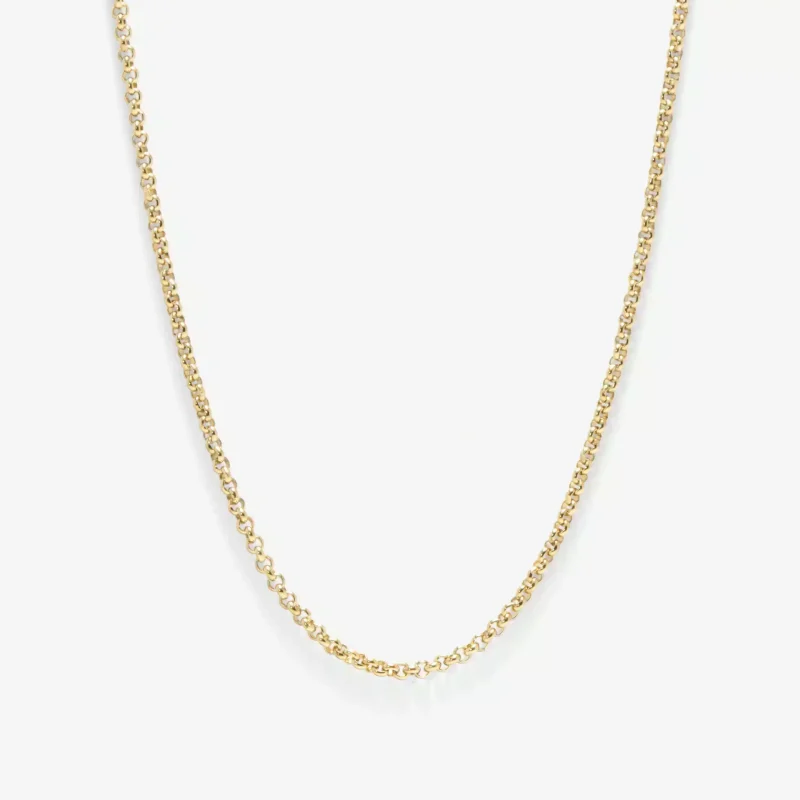
If you want colour that holds without the upkeep, the Dainty Chain and the Rolo Chain are made from recycled stainless steel with a 14k gold PVD coating, so they keep their tone through water, sweat and daily wear, where a reactive metal would soon dull in the drawer.