

If your skin has ever flared red under a favourite piece, you will know the small disappointment of taking it off and wondering what went wrong. The best jewellery for sensitive skin is made from metals that release very little of the ions that trigger reactions: titanium, surgical 316L stainless steel, high-karat gold, platinum and sterling silver. The usual culprit behind irritation is nickel, found in brass and cheap alloys, so choosing nickel-free pieces is the single most useful step you can take.
Why some skin reacts to jewellery
Skin reactions to jewellery come from an immune response called contact dermatitis. The skin becomes sensitised to a particular metal ion after repeated exposure, and once that happens, even brief contact can set off redness, itching and sometimes blistering under the piece. It is a delayed reaction, so symptoms often appear hours or a day after wearing something, which is part of what makes the cause so easy to miss.
This sensitivity is individual. Some people can wear almost any metal without trouble, while others react to one metal and tolerate the rest. Sensitivity can also develop at any age, which is why a piece worn happily for years can suddenly start to irritate. Sweat and the slightly acidic pH of skin speed up how fast metal ions are released, which is why reactions often show up in warm weather or during exercise.
Once it has developed, a metal sensitivity tends to stay with you, so the practical aim is to limit contact with the metal that causes it. For most people that means nickel, and steering clear of it removes the problem for the great majority of reactions. The reassuring part is that the safe options cover most jewellery styles, so avoiding a trigger metal still leaves you plenty of the pieces you actually want to wear.
What jewellery irritates skin, and what to avoid
Nickel causes most jewellery-related skin reactions. It is cheap, hardens alloys and adds a pale silvery colour, so it turns up in base-metal jewellery and some gold and silver alloys. Brass and inexpensive mixed alloys are the common offenders, and a piece sold as gold-plated can still carry nickel in the metal underneath.
A few other metals cause trouble for some people. Cobalt and chromium can both provoke reactions, though less often than nickel, and cobalt sensitivity can show up even in pieces labelled nickel-free. Copper is a separate case: it reacts with sweat and can turn skin green, a temporary chemical stain that washes off and is harmless to most skin. To stay comfortable, the pieces to leave on the shelf are unbranded base-metal jewellery and anything where the metal content is not stated.
How a piece is worn affects the risk as much as what it is made from. A reaction needs ongoing contact, so a thin layer of plating that has worn through, a piece kept on while sweating or showering, or jewellery worn on broken skin all raise the chance of trouble. This is why a solid biocompatible metal, or a sealed surface that limits metal contact, gives more peace of mind than a thin coating over an unknown base.
The best metals for sensitive skin
For sensitive skin, a handful of metals are dependable. Titanium is the most hypoallergenic option, lightweight, corrosion-resistant and used in surgical implants, which makes it a safe pick for people with several sensitivities. Surgical or 316L stainless steel is well tolerated and a practical, hard-wearing everyday choice, as long as the piece is confirmed as 316L and nickel-free.
High-karat gold at 14 or 18 carat is biocompatible and a good choice, with 18 carat preferred because it contains more gold and less of other metals. Platinum is highly biocompatible and holds its finish well, with cost the main trade-off. Sterling silver suits most people, though a few react to its small copper content, and for them finer silver is gentler. Choosing from this group is the most reliable way to settle on the best metal for sensitive skin.
For day-to-day wear on a sensible budget, 316L stainless steel does a lot of work. It is hard, holds up to water and knocks, and is low enough in nickel that most people wear it without any reaction. That mix of comfort and toughness is why it has become a standard base for everyday jewellery, and why a gold tone is usually added to it as a bonded coating that outlasts a soft plating.
How PVD coating helps sensitive skin
PVD coating adds a sealed barrier that reduces how much the underlying metal touches your skin. Physical vapour deposition bonds a hard, dense layer onto the base metal in a vacuum, and that layer limits the release of metal ions while it stays intact. On 316L stainless steel, which is already low in nickel and well tolerated, a PVD finish gives a comfortable, hard-wearing surface for daily wear. If you want the process explained, see our guide on what PVD jewellery is.
The barrier holds while the coating does, so a quality finish matters. A well-applied PVD coating on stainless steel keeps its surface for years of daily wear. Caring for your pieces, keeping them clean and dry, helps the finish last and keeps that barrier doing its job. For everyday earrings, necklaces and bracelets, PVD-coated stainless steel is one of the more comfortable choices for reactive skin.
What "hypoallergenic" really means on a label
Hypoallergenic is a helpful starting point, and it falls short of a guarantee. The word has no regulated definition for jewellery in most countries, so it can mean the metal rarely causes reactions, that the piece is coated to limit ion release, that it is nickel-free by specification, or simply that the maker expects it to be gentle. There is no standard test behind it.
So treat the label as a prompt to look closer. A piece described as hypoallergenic could still contain nickel, or could expose a reactive base metal if a thin plating wears through. The reliable signal is clear information about what the piece is actually made from: a named metal such as titanium or 316L stainless steel, confirmation that it is nickel-free, and a stated finish. When a seller can give you that, you can buy with confidence.
Choosing earrings for sensitive ears
Earrings deserve extra care, because the post sits in constant contact with skin in a warm, slightly moist spot, which raises the chance of a reaction. Titanium or solid gold posts are the safest, and 316L stainless steel posts suit most people well. PVD-coated stainless steel works comfortably for everyday wear, since the sealed surface keeps metal contact low. For anyone with sensitive ears, simple hoops or huggies in one of these materials are an easy place to start.
If a new pair does cause irritation, take them out, let the skin settle, and check the material specification before trying again, since the issue is usually the metal or a worn coating, with the style itself rarely to blame. Keeping the ears and the posts clean and dry between wears also lowers the chance of a flare-up, and gives a fair test of whether a material suits you.
FAQ
What jewellery doesn't irritate skin?
Jewellery made from titanium, surgical 316L stainless steel, high-karat gold, platinum, or sterling silver rarely irritates skin. PVD-coated stainless steel also suits sensitive skin, because the coating seals the surface and reduces metal contact.
What is the best metal for sensitive skin?
Titanium is the most hypoallergenic metal, followed by surgical 316L stainless steel, high-karat gold, platinum and sterling silver. The right pick depends on your budget and whether you react to the small copper content in sterling silver.
Is nickel-free jewellery safe for sensitive skin?
For most people, yes, because nickel causes the majority of jewellery reactions. Confirm the metal is genuinely nickel-free, since a piece can still carry nickel in a base metal beneath a plating.
Is PVD jewellery hypoallergenic?
PVD-coated jewellery on 316L stainless steel suits most sensitive skin, because the coating seals the surface and the base metal is low in nickel. The barrier works while the coating stays intact, so a quality finish and basic care matter.
Related pieces
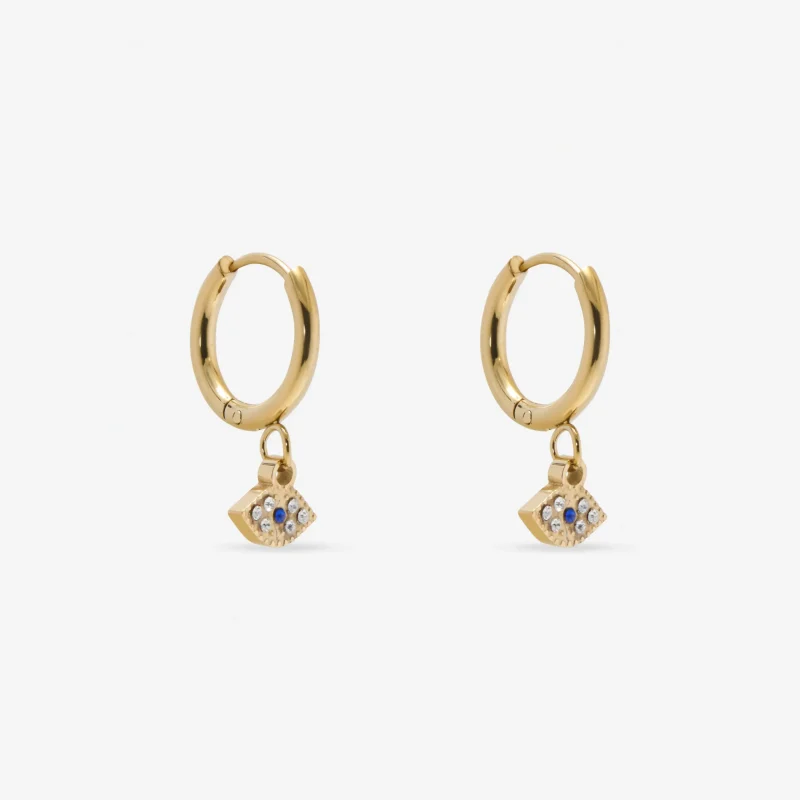
Evil Eye Huggie Earrings
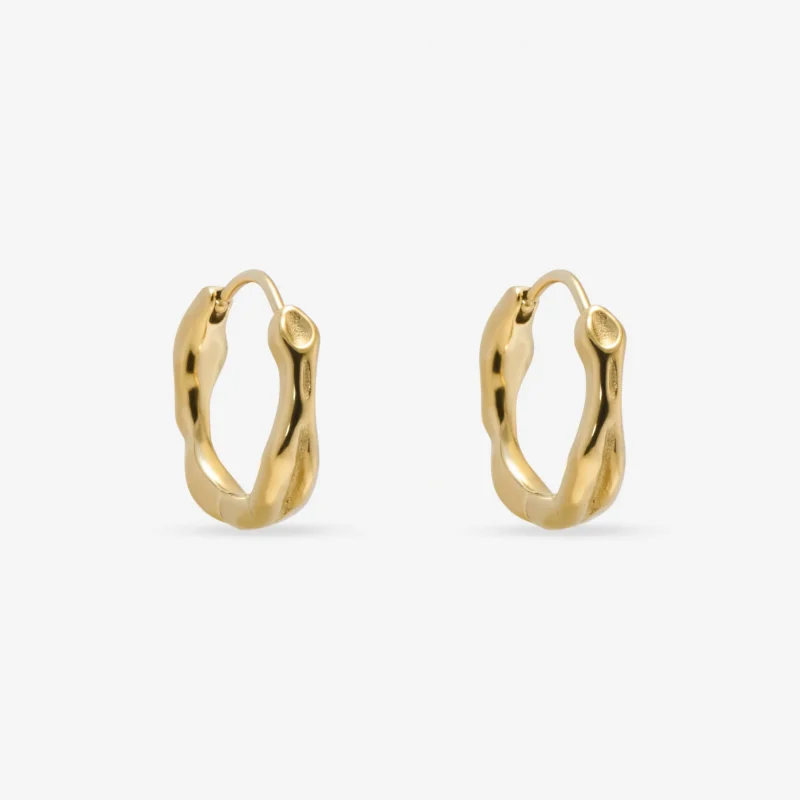
Molten Hoop Earrings